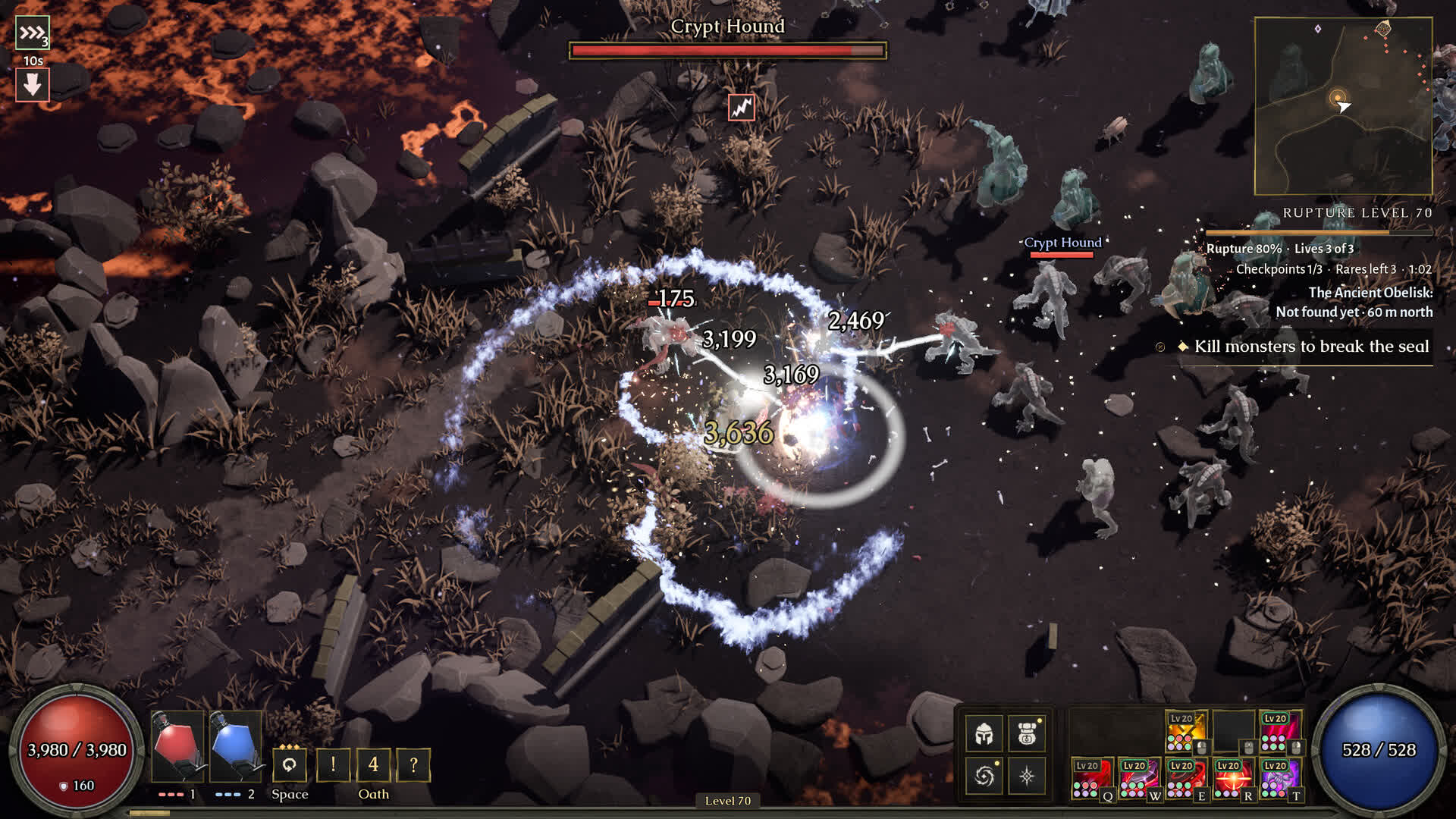
The long grind: what to chase after the campaign
Crater Studios says Broken Oath is built to reward you from your first fifteen minutes to your two-hundredth hour. That is a design promise, not a content list. This page turns the confirmed endgame pieces into a loop you can actually follow.
The loop
Every ARPG endgame is a loop of clear, evaluate, upgrade, climb. Broken Oath’s version is shaped by randomised Ruptures and a band map, which means the loop is less about a fixed route and more about choosing the right difficulty on any given night.
| Stage | Goal | Exit test |
|---|---|---|
| 1. Stabilise | Clear a band without spending all three lives | Two consecutive runs with one death or fewer |
| 2. Speed up | Reduce time-to-kill and travel time | The same band feels boring, not dangerous |
| 3. Gear check | Fix the slot that is holding you back | One meaningful upgrade per session |
| 4. Forge | Convert rune stones and materials into a reliable upgrade | A crafted item beats your current slot |
| 5. Climb | Enter the next band | You can still clear the previous band without thinking |
| 6. Chase | Farm uniques and Primal items | The build works without them |
Bands are a farming tool, not a ladder
The map has eight bands. It is tempting to treat them as a one-way climb. In practice, the best farming band is usually one or two below your maximum. You clear faster, die less and see more loot per hour. The maximum band is for testing, not for living.
The Level 150 test
The developer’s 6 November weekend ask is the clearest endgame target we have: get every class and as many builds as possible past Rupture Level 150, and report what worked. That is not a cap; it is a balance probe.
“I want to see every class and as many builds as possible past Rupture Level 150, and I will read every build and every report to get the balance right.”
Use the level-150 ask as a direction, not a finish line. If your build can clear 150 but takes ten minutes per rare, the build has a problem the number does not show.
Gold and respecs
The HUD shows gold (for example “2 gold” and “160 gold” in different screenshots), and the passive tree says refunds cost 2 gold a node. That makes gold a respec currency at minimum. Whether it also buys gear, stash space or Forge services is unknown.
- Do not spend gold on cosmetic respecs during the campaign. Save it for a real tree change.
- If a patch changes your main skill, a gold respec is cheaper than a new character.
- Track your gold per run. If a band costs more in respecs than it earns, move down.
What you are actually chasing
There are four endgame goals, and they pull in different directions:
Higher bands
A difficulty goal. Rewards testing, punishes greed.
Build completion
The unique, support or craft that makes the engine click.
Primal items
A lottery. Treat it as a bonus, never a requirement.
Mastery
Learning Guardian phases and modifier overlaps well enough to clear without panic.
A weekly routine that respects your time
-
One push run
Try the next band once. If it fails, go back down without shame.
-
Three farm runs
Clear a comfortable band for materials and gold. Use the run log.
-
One Forge session
Spend rune stones and materials. Craft one slot, not five.
-
One review
Read your notes. Cut the skill or support that is not earning its slot.