Build primer: seven layers, one character
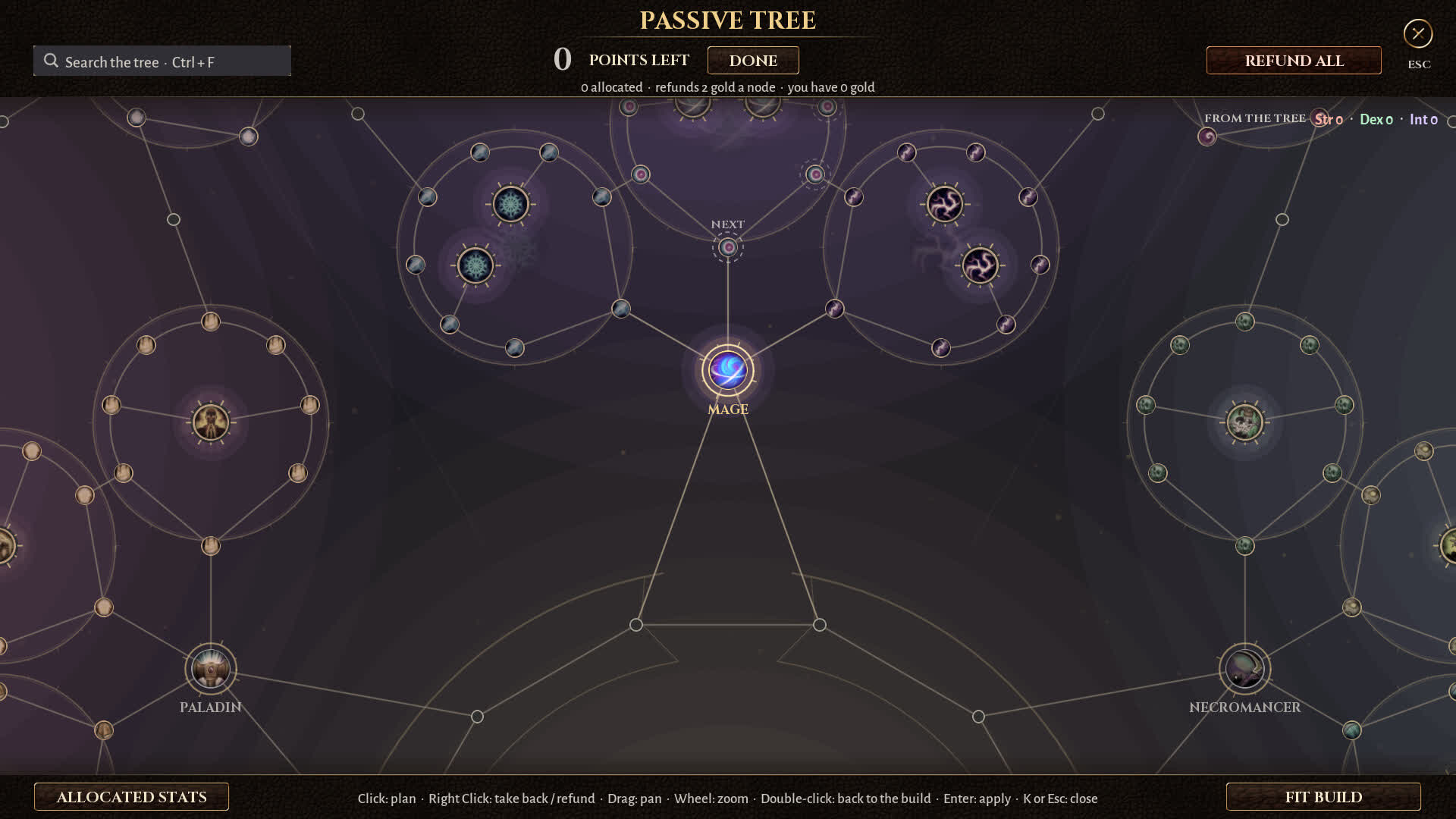
There are no public Broken Oath builds. There is a confirmed system stack, a passive tree screenshot and enough genre literacy to plan a character that will not collapse the moment a patch moves a number. This is the framework, not a copy-paste build.
The seven layers
| Layer | Question | Confirmed hook |
|---|---|---|
| 1. Engine | What actually kills things? | Skill gems with supports |
| 2. Delivery | How does it reach the pack? | Melee, projectile, channel, minion, damage over time |
| 3. Scaling | What multiplies it? | Passive tree notables and keystones; attributes |
| 4. Burst window | When is the damage highest? | Blessings and Curses: Vows, Woe, marks |
| 5. Defence | What stops the one-shot? | Life, armour, evasion, block, minions, distance |
| 6. Sustain | What keeps you running? | Mana, flasks, life recovery, resource costs |
| 7. Gear | What is worth chasing? | Magic, rare, unique, Primal; Forge crafting |
Start with the engine
The store’s examples all describe an engine, not a class: Cyclone firing Ember Bolts, a burning legion, elemental arrows. The lesson is to choose the interaction you want to watch for two hundred hours, then pick the class and tree that get it online fastest.
Defence is a layer, not a number
The HUD gives you life, mana, two flasks and a movement key. That is the baseline. Everything else — armour, evasion, block, minion bodies, distance — is a layer you choose. The mistake is to stack three half-layers instead of one real one.
- Armour/life: the most readable. Good against many small hits; weak to big elemental slams unless you add resistance.
- Evasion/dodge: strong until it is not. Pair it with a second layer for the hit that gets through.
- Block: excellent if you can reach a reliable chance; useless at 20%.
- Minions: a layer that also does damage, but unreliable in corridors and against bosses that ignore them.
- Distance: the cheapest layer and the one most players forget. A Ranger who never gets hit does not need armour.
Sustain is where pre-launch builds go wrong
Every support has a cost. The store does not publish mana multipliers, but the HUD’s large mana globe and two flask slots tell you resource management is a real system. A build that needs a full globe per pack will stall in a long Rupture.
- Can your main skill run for a full pack without a flask?
- Does your movement skill share a resource with your damage skill?
- Is your life recovery passive, active or flask-only?
- What happens when the boss fight lasts three minutes?
- Which support would you cut first if mana becomes a problem?
Use the worksheet
The wiki has a static build worksheet that saves to your browser. It asks the seven questions above and exports a Markdown plan you can keep next to your character. It does not calculate game numbers, because there are no reliable numbers yet. It is a thinking tool.
How to keep a build alive through patches
-
Write the plan down
A build you cannot remember is a build you cannot debug.
-
Keep one flex slot
One support, one aura or one gear slot should be changeable without rebuilding the tree.
-
Track the failure, not the damage
When a run ends, note what killed you. Damage upgrades rarely fix a defensive hole.
-
Re-read the patch notes
Early Access patches can change skills, supports, uniques and progression. The wiki dates every page for this reason.